


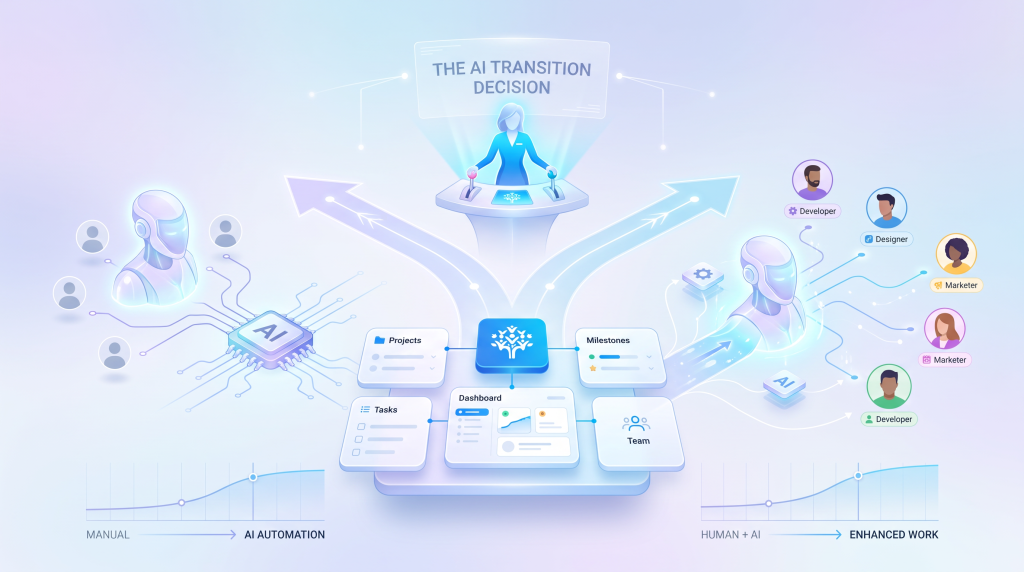
A 250-year look at what actually happens when technology reshapes work, and the surprising role PMs are about to play in the AI transition
The conversation every PM is about to have
Sometime in the next 18 months, if it hasn’t happened already, you’re going to be in a planning meeting where someone, probably an executive, possibly a board member, asks a version of this question:
“How many of these roles can AI absorb?”
How you frame the answer is going to matter more than you think. Not just for your team. For the much bigger question of whether the AI transition becomes a generational catastrophe for knowledge workers or the most productive collaboration between humans and tools in modern history.
The honest answer to that question is buried in 250 years of automation history. I just spent serious time going through the academic literature, David Autor at MIT, Daron Acemoglu (the Nobel winner), Anton Korinek at the IMF, the Anthropic Economic Index researchers, the team at Epoch AI. What the historical record actually says is uncomfortable, and most of the loudest voices in the AI-and-jobs debate are getting it wrong.
It says project managers, team leads, and the people who design how work gets done, the people who use tools like Freedcamp every day, are going to be the deciding variable in how this wave plays out.
Here’s why.
The story everyone tells about automation, and the part they leave out
You’ve heard both halves of the debate. AI is going to take everyone’s job and we’re heading for mass unemployment. Or, AI is just another tool wave like electricity and personal computers, disruptive in the short term, net positive in the long run, nothing to worry about.
Both halves are wrong, and the historical record tells us why.
Start with the Industrial Revolution between 1750 and 1850. Everyone’s favorite “see, automation works out fine” example. The British economy industrialized, productivity exploded, the modern world was born, life is dramatically better now than in the 18th century. All true.
Here’s what gets left out. Between roughly 1790 and 1840, British per-capita GDP rose by 46%. Working-class real wages rose by 12%. The economist Robert Allen called this “Engels’ Pause”, fifty years during which the gains from industrialization flowed almost entirely to capital owners while ordinary workers’ living standards barely moved. Life expectancy in industrial cities actually fell. Child labor in textile mills exploded. Skilled artisan weavers, whose craft had taken years to learn, were replaced by power looms tended by 10-year-olds.
The Luddites, popularly remembered as irrational machine-haters, were skilled workers facing specific, identifiable machines that were destroying their trades during a wartime depression. They were trying to negotiate. The British state’s response was to deploy 12,000 troops to crush them, more than Wellington commanded at the Battle of Vitoria. Hobsbawm called it “collective bargaining by riot.”
The Industrial Revolution wasn’t a smooth handoff. It took two generations. It broke a lot of people along the way. And the political consequences, socialism, the labor movement, decades of class conflict, outlasted the technological transition itself.
This pattern repeats. Every major automation wave follows the same shape: the aggregate economy benefits, eventually. The specific people in the path of the change pay the bill, immediately.
The 6.7 million person example that nobody talks about
The largest single-occupation mass displacement in modern American history didn’t happen in a factory. It happened on farms.
In 1950, the United States had 7.6 million self-employed and family farmworkers. By 2000, that number was 2.06 million, a 73% reduction. Add another 1.2 million hired farmworkers displaced. Roughly 6.7 million people, in the lifetime of someone now collecting Social Security, watched their occupation disappear.
There was no permanent unemployment crisis. Why?
Because of an extraordinary policy bundle that we now treat as background scenery: the New Deal’s social insurance, World War II war production absorbing millions, the GI Bill putting a generation through college, federally subsidized suburbanization creating millions of construction jobs, and a fifty-year run of services-sector growth.
Without that bundle, the agricultural transition would have looked like contemporary opioid-crisis Appalachia: mass abandonment, generational decline, communities that never recovered. The transition worked because institutions worked. The institutions worked because we built them, most of them as direct responses to the Great Depression, which was itself partly a symptom of the previous wave of unmanaged displacement.
The lesson is not “markets clear.” The lesson is “markets clear conditional on institutions that take decades to build, and those institutions don’t appear spontaneously when needed.”
For AI? No equivalent policy bundle is currently on the table. Not in the United States, not in Europe, not anywhere.
Why AI is genuinely different (and why that matters for knowledge work)
Most “AI is different” claims dissolve under inspection, they turn out to be restatements of existing economic frameworks. But there are three places where the current AI wave genuinely diverges from every prior pattern, and all three of them matter directly to project managers and knowledge workers.
First: this wave is coming for cognitive work, not physical work.
From the Spinning Jenny through industrial robots, automation hit physical and routine cognitive tasks first while sparing creative and high-end cognitive work. AI does the opposite. The Anthropic Economic Index, which analyzed more than four million real-world AI conversations, found that 37% of usage falls in computer and mathematical occupations, 10% in arts, design, media, and writing. Farming, fishing, and forestry register 0.1%. This is the precise inverse of the robotics era.
Eloundou and colleagues at OpenAI reached the same conclusion from the task-exposure angle: roughly 80% of the US workforce has at least 10% of their tasks exposed to large language models, and, this is the part that should make any knowledge worker pay attention, higher-income occupations face more exposure, not less.
The tasks that show up most heavily in current AI usage are precisely the tasks that fill modern project management work: status updates, meeting summaries, document drafting, requirements gathering, ticket triage, stakeholder communication, sprint retrospectives, project documentation. If you’re a PM reading this, you know which of your own tasks I’m describing.
Second: the diffusion speed is unprecedented.
Personal computers reached 20% adoption three years after the IBM PC launched. The commercial internet reached 20% adoption two years after NSFNET decommissioned. Generative AI reached 39.4% of US adults in less than two years. The structural reason matters: AI rolls out as software over an already-ubiquitous digital infrastructure, with a natural-language interface that requires zero training. Prior general-purpose technologies needed new factories, new wiring, expensive hardware. This one doesn’t.
For organizations, this means the adoption curve will outpace your change-management cycle. The traditional pattern, pilot, then small-scale rollout, then broad deployment, assumed technologies that diffused over years. AI is diffusing in months. Most companies’ adoption is being driven bottom-up by individual workers using free tiers of consumer products, not by any formal process.
Third: the capital structure is concentrated in a way no prior wave was.
Training a frontier AI model now costs hundreds of millions of dollars, and the required compute is growing roughly 4-5× per year. The result is an oligopoly of frontier providers, OpenAI, Google, Anthropic, Meta, plus a few Chinese labs, with no historical analogue. Anyone with a factory could buy electric motors. Anyone with a phone line could connect to the internet. Not anyone can train a frontier model. The gains from frontier AI accrue in the first instance to the compute owners, not to the workers using the tools.
This is the structural reason the labor share of national income, the fraction of GDP that flows to workers rather than to capital owners, has been declining for forty years, and why most credible scenarios suggest AI accelerates that trend.
What the serious researchers are actually arguing about
The credible literature on AI and jobs clusters into three identifiable camps. They disagree sharply about outcomes but agree remarkably on the parameters of the disagreement, which is what intellectual progress looks like before a question is fully resolvable.
The skeptics, led by Daron Acemoglu, apply standard task-based macroeconomic models to existing AI productivity estimates and conclude the aggregate effect is bounded, no more than about 0.66% in total factor productivity gains over a decade. He explicitly calls out the Goldman Sachs forecast of a 7% global GDP boost as unsupported by data or theory. Tyler Cowen adds a related deployment-friction skepticism: the bottleneck isn’t the technology, it’s the humans, institutions, and processes that have to adapt around it.
The moderates, with David Autor at MIT as the leading voice, argue aggregate employment will probably be fine but distribution will be brutal. Autor’s framing is precise and worth memorizing: the labor market might be 5% better on average, but it could be 90% worse for some people and 95% better for others, with no one actually experiencing the average. His recent work argues that AI could plausibly expand middle-skill employment by lowering the expertise barrier for high-end tasks, but only if deployed deliberately. That conditional carries the entire argument.
The accelerationists, including Anton Korinek’s formal NBER work, Carl Shulman’s interviews, and Epoch AI’s growth modeling, take seriously the possibility that the next decade or two brings transformative AI. Epoch’s GATE model, under what they call conservative assumptions, finds compute investment could exceed 10% of world GDP and growth rates could be 2-20× the historical average. The median forecaster timeline for artificial general intelligence compressed from 2042 in 2022 surveys to 2032 in 2024 surveys. That’s a data point, even if you discount it.
These three camps are not arguing about ideology. They’re arguing about three specific parameters: how substitutable AI capital is for human labor, how fast complementary investment can be made, and where the upper bound is on task complexity in the human comparative-advantage set.
Where project managers come in
Here’s the part the AI-and-jobs debate keeps missing.
Autor’s “deploy deliberately” conditional is not a philosophical observation. It’s an operational one. It’s a choice that gets made, task by task, project by project, sprint by sprint, by the people who design how work gets done inside organizations. That’s project managers, team leads, operations leaders, and the senior individual contributors who shape team workflows.
The economics literature treats AI deployment as if it’s an exogenous variable, something that happens to companies. It isn’t. It’s a hundred thousand decisions about whether to use AI to augment a human’s work or replace it. About whether the productivity gains from AI go into higher output with the same headcount, or the same output with lower headcount. About whether the tool gets adopted as a partner that lowers the barrier to high-skill tasks, or as a substitute that erases junior roles.
That choice gets made by people running projects. Not by economists, not by policymakers, not by AI labs.
The ATM is the canonical case study. Everyone trots out the same statistic: bank teller employment in the United States rose from roughly 300,000 in 1970 to nearly 600,000 by 2010, even as ATMs proliferated. The story goes that ATMs lowered the cost of operating a branch, banks opened more branches, and the role of the teller shifted from cash-dispensing to relationship-selling.
What the story usually omits is why that happened. The teller-to-relationship-manager pivot wasn’t automatic. It required banks to redesign the job, to define new responsibilities, to retrain staff, to restructure compensation. Banks that did it well grew employment. Banks that didn’t, shrunk it. Same technology, different operational choices, different labor outcomes.
The AI version of that decision is being made right now, in every organization, every quarter. And it’s being made by the people closest to the work, which means project managers and team leads have more leverage over the macroeconomic outcome of this transition than they probably realize.
What “deploying deliberately” actually looks like
This is where the historical record translates into operational practice. The pattern that produced reabsorption rather than displacement, in every successful prior transition, has the same shape regardless of the technology:
Redesign jobs around the tool, instead of optimizing the tool to eliminate jobs. The bank-teller-to-relationship-manager pivot. The clerk-to-business-analyst pivot of the early computerization era. The blacksmith-to-machinist pivot of the early Industrial Revolution. None of these happened spontaneously. They required management decisions about what people would do with the time the tool freed up.
For a PM running AI deployment on a team, the operational question is: when AI cuts the time required for a task from four hours to forty minutes, where does the saved time go? Into shipping more work with the same team? Into raising the quality bar on the work you already ship? Into giving the team time for the higher-judgment work that the tool can’t yet do? Or into headcount reduction?
The first three are the bank-teller path. The fourth is the hand-loom-weaver path. The choice is yours to make.
Map task-level exposure, not job-level exposure. Autor’s framework matters here: jobs are bundles of tasks, and AI substitutes for some tasks within a job while complementing others. The job rarely disappears wholesale; the composition of the job shifts. PMs who can do task-level mapping of their team’s work, which tasks are now AI-assisted, which remain pure human judgment, which require the new skill of validating AI output, can intentionally rebalance roles before the rebalancing happens to them.
This is operational work. It’s the kind of thing you do in a project management tool. It’s a planning exercise. PMs are uniquely positioned to do it because they already think this way.
Invest in the human side of the workflow at the same speed as the AI side. Every prior automation wave produced a productivity boom when, and only when, complementary organizational investments matched the technological ones. David’s “dynamo and the computer” paper is the canonical demonstration: electric motors were available from the 1880s, but manufacturing productivity statistics didn’t register their effect until the 1910s and 1920s, thirty years later, after factories had been physically redesigned around unit drive instead of being retrofitted around the central shafts of the steam era.
The AI equivalent is the workflow redesign that needs to happen around the tool. Most organizations are currently retrofitting AI onto existing processes. The productivity payoff and the labor outcomes both improve dramatically when the process gets redesigned around the tool’s actual strengths. PMs are the people who design those processes.
Make the augmentation-vs-substitution choice explicit and surface it to leadership. This is the hardest one. The current default in most organizations is that the augmentation-or-substitution decision gets made implicitly, project by project, often by people without the standing to push back when leadership defaults to substitution. The PMs who survive this transition best, and the ones whose teams survive it best, will be the ones who make the choice explicit and force the conversation upward.
The honest forecast
Across the credible literature, the modal scenario for the next 10–20 years is this: aggregate employment stays near historical norms. Occupational composition shifts dramatically. Wage polarization deepens. The labor share of national income, already in a four-decade decline, continues to decline and possibly accelerates. The cost concentrates on specific cohorts, junior knowledge workers, mid-career professionals in language-intensive jobs, recent entrants to translation, copywriting, paralegal work, junior programming, customer service, and graphic design.
A meaningful minority probability attaches to a more disruptive scenario where cognitive automation outpaces capital adjustment and produces broader wage compression. A small but non-trivial tail probability attaches to transformative scenarios where the standard task-based framework breaks down entirely.
The variable that determines which scenario your team actually lives in is not the technology. It’s the operational choices made by people who run projects.
The Luddites were right about themselves
The quietly devastating fact from all this research is that the Luddites were not wrong about what was happening to them. Their trade was destroyed. Their livelihoods were destroyed. Their political power was destroyed by 12,000 government troops. In the aggregate and over a long enough time horizon, the Industrial Revolution worked out fine, but not for them, and not for their children.
When people argue today that AI is “just like every other automation wave,” they’re making a true statement about the aggregate that is consistent with the historical record producing devastation for specific identifiable groups of people. The question the next twenty years actually asks, the one the academic literature can’t answer for us, is whether the institutions, the operational practices, and the daily decisions of the people who design how work gets done can make this transition something other than another generation paying for everyone else’s productivity gains.
That’s not a technology question. It’s a management question. It’s an organizational design question. It’s a project management question.
It’s the kind of question the people who use Freedcamp every day are uniquely qualified to answer, because the answer doesn’t get worked out in white papers or congressional hearings. It gets worked out in the next sprint planning meeting, the next roadmap review, the next quarterly headcount discussion.
The choice you make about how to deploy AI on your team this quarter is, quietly, one of the small decisions that adds up to whether the 2030s look like the 1830s or the 1950s.
Choose deliberately.
This essay draws on a 9,000-word research synthesis covering the work of David Autor, Daron Acemoglu, Pascual Restrepo, Carl Benedikt Frey, Anton Korinek, Joseph Stiglitz, Erik Brynjolfsson, Tyler Cowen, Carl Shulman, Epoch AI, and the Anthropic Economic Index team, alongside the historical record of major automation waves from 1750 to 2020. Full citations available on request.
Freedcamp has been one of the longest-running free project management platforms, long enough to have seen the SaaS wave, the mobile wave, the remote-work wave, and now the AI wave reshape how teams plan and ship work. The pattern of “what survives a wave is the discipline, not the tool” is one we’ve watched up close.
Start your next project in two minutes
Freedcamp is free for unlimited projects, tasks and users. No credit card, no trial clock.
Comments
0